
legend of zelda
Games I am Thankful For: The Legend of Zelda: A Link to the Past
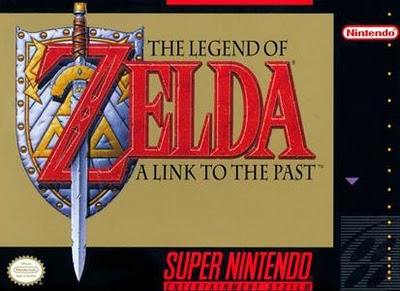 In the I-guess-this-is-an-annual-thing department, the game I am thankful for this year is The Legend of Zelda: A Link to the Past. Not that I've played it in years, or even thought about it much lately, but the only Super Nintendo Zelda entry is just one of those perfect gaming experiences that you can never quite escape, not that you would want to.
Last year I talked about Harvest Moon and before that a series of influential multiplayer games.
I remember the first time I played it, probably around 1994 at a cousin's house in Neenah, Wisconsin (which also happened to be the first place I ever played Super Mario Bros., but that was years earlier). They were far enough in the game that they could summon the little bird with the flute that could warp you around the map, which made exploration a bit easier, but obviously would have ruined part of the game experience if I had understood the logistics of the world a bit better. But luckily, my future exploration of Hyrule wasn't destroyed by this brief warp-around.
Link's Crossbow Training
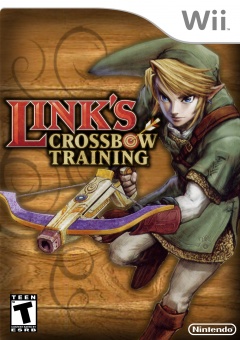 Remember when Nintendo gave Link a gun? I did when I found this baby at the media exchange shop. I wish I could say I just scored a Zelda game for a dollar, but there’s actually no “Legend of Zelda” in Link's Crossbow Training, so that would be incorrect. Also, it was two dollars.
It seems blasphemous to send Link on an adventure without his trusty sword and shield, but is it outrageous that I’m kind of excited about the idea? Zooming the Wii remote’s infrared pointer around is my favorite aspect of playing Wii games, and my best memories of Twilight Princess involved loosing arrows at goblins from horseback. Seriously, if this game lets me shoot Ganon in the face with some crossbow bolts, I may have to give it a perfect score.
I guess that seems unlikely, as any confrontation with the ultimate evil is unlikely to happen during crossbow “training.” I’ll probably just shoot targets and maybe a goblin or two. But maybe someday I’ll get my sequel, my Link’s Crossbow Conquest...
2011 Game of the Year Awards
 Announcing the 2011 Game of the Year Awards from First Hour!
These aren't your normal awards, we cover everything from older game of the year to worst first hour. We also don't sum up votes on categories or anything either, we simply present each writer's thoughts on their pick, so if you don't like something, you know exactly who to blame! Of course, we do all this just for fun (spare time!) and buy all of our own games (real money!), so most of us don't even touch some of the big releases of the year. Woe to the unpaid game critic!
The Legend of Zelda: Skyward Sword
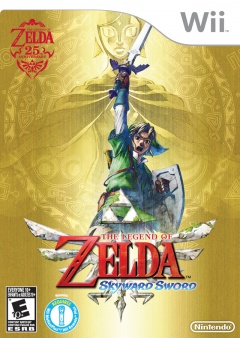 The Legend of Zelda: Twilight Princess was my primary reason for buying a Wii at launch. It left me feeling disappointed and greatly annoyed. Five years later, beating The Legend of Zelda: Skyward Sword on my second Wii (after selling my first just days after beating Twilight Princess) leaves me with nearly the opposite effect: I loved it and am slightly giddy to write a review about it before the end of the year.
I was definitely not feeling the game a few hours in. Twilight Princess’ first hour is awful and Skyward Sword’s is arguably worse, and the ramp up feels tedious. My list of annoyances was longer than any kind of enjoyment I was getting out of the game, but once the game does ramp up, it does it incredibly successfully.
So as the Wii’s last hurrah, Skyward Sword leaves a great impression, here’s my review of the latest Legend of Zelda game, released in November. This is our second full review of the game, following Nate’s from last week. I re-read his review in preparation for my own, and have to say I agree on basically every point. So hopefully this review won’t be longer than it needs to be, but if you have some time, do read his write-up.
The Legend of Zelda: Skyward Sword
The lasting impression from my recent introduction to the original
Legend of Zelda was its unstructured progression. With only a ghost of a
narrative driving the action and few barriers to limit wanderlust, the
course of my trip through Hyrule was almost entirely up to me. Having played Ocarina of
Time before any other Zelda game, I was surprised to see just how
hands-off the original was.
In contrast, last month's Skyward Sword may be the most linear Zelda experience yet. The newest quest sees Link flying from one compact landmass to the next with hardly any room for side trips. The vast sky of islands is sparser than Wind Waker's nearly endless ocean, and even the surface world below is but three masses of land separated by impenetrable mountain ranges and deserts and forests. This is a Zelda where the path to the next waypoint is often the only path.
Every game in the series since the eighties original has trended towards structure and direction as story progression and ability acquisition gained a greater share of the Zelda spirit. Aesthetic similarities and recurring tropes aside, The Legend of Zelda and Skyward Sword could be mistaken for two wholly separate franchises. For better or worse, Skyward Sword feels like the end state of a slow evolution that Nintendo has been cooking for twenty-five years.
The Legend of Zelda: Skyward Sword [Video]
With so many Legend of Zelda re-releases in 2011, I've had several
excuses to reacquaint myself with the series for the last six months. I
awakened Link for the first time, replayed bits of the first Zelda game I
ever experienced, tried out a solo retrofit of the franchise's
multiplayer experiment, and even charted my way through the legend that
begot legends. For me, 2011 has been the year of Zelda.
Through this trip back through time, I've reevaluated my regard for Nintendo's beloved adventure franchise, and just in time for the newest iteration. Skyward Sword, at a glance, looks like just another Zelda, which is enough for most fans but insufficient for me. On top of that, the game boasts a distinct watercolor style, a sky/land dichotomy, and what appears to be an origin story for many of the franchise's trademark elements.
What has me excited is the motion-controlled combat. I loved the MotionPlus combat in Red Steel 2, and Skyward Sword uses the gyroscope add-on to provide needed nuance to Zelda's normally dull swordplay. Comparisons to Punch Out's puzzle-like duels have me salivating all the more.
Unfortunately, I didn't get to experience much of that in Skyward Sword's opening sixty. That's disheartening enough, but Skyward Sword doesn't stop at mere disappointment...the game outright insults me. Take a look:
2011 holiday releases and no preorder for Skyward Sword
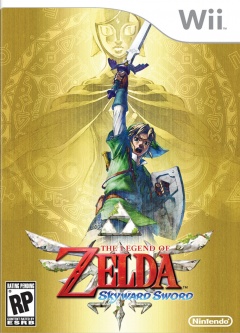 We’re just a few weeks away from the release of The Legend of Zelda: Skyward Sword, which in turn caps a pretty amazing holiday buying season for console games. Gears of War 3, Batman: Arkham City, Battlefield 3, Uncharted 3, Modern Warfare 3, The Elder Scrolls V: Skyrim, Assassin’s Creed Revelations, and Skyward Sword are all being released within just weeks of each other.
Every year, more and more huge titles are crammed into the holiday schedule, grade inflation becomes rampant, wallets are emptied, and I seem to miss out on more and more games. But this year, I’m missing out on them mostly because I just don’t have any time to play games these days. I’d love to play Arkham City and give Battlefield 3 a try, but I’ve only managed to play four whole hours of Professor Layton and the Last Specter in the past week, which is why our content has been a bit dry lately.
Which leads me back to The Legend of Zelda: Skyward Sword, I’m usually frothing at the mouth for the latest adventure of Link, but through a combination of Twilight Princess still stinging and just being sick of the Wii, I’m not preordering the game. I have preordered every console Zelda game since Ocarina of Time back in 1998.
The Legend of Zelda
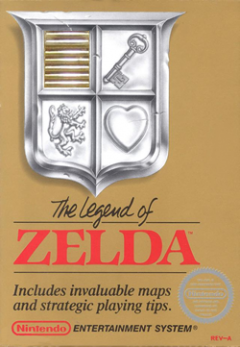 Achievement Unlocked: Review a game older than you.
Zelda may be the most beloved video game franchise, but I've never counted myself among series super-fans. Since cutting my teeth on the series with Ocarina of Time, I've merely enjoyed all but a handful of games in the series. Don't get me wrong, they're all great, but I wouldn't put any in my top ten.
That said, I like checking out each title and comparing it with the rest of its ilk. Other than the experimental black sheep Zelda II: Adventure of Link, the first Legend of Zelda may be the series' most divisive game. Fans can't seem to agree whether the game's old school difficulty and unguided progression make it dated or just different. Lacking an in-game overworld map and never funneling players away from difficult areas, the NES original certainly requires more of its players than any Zelda since.
Nintendo recently launched its 3DS Ambassador program, giving the system's early adopters ten free NES games. I had been meaning to check out several of the ambassador titles, but none more so than The Legend of Zelda. Fifteen hours and a princess rescue later, I'm ready to weigh in on the Dated vs. Different debate.
Top 10 Video Game Commercials of All Time
 We've all grown up among an onslaught of advertisements. It is almost impossible to look anywhere in a semi-urban place and not see some sort of ad. Television has perhaps been their most successful medium, and video games have been advertising on the same tube we play them on for as long as they have been around.
So to celebrate the hundreds of video game ads, we present the Top 10 Video Game Commercials of All Time. This is the definitive list, carefully developed by our writers and then culled down by Greg and Nate. Blood was shed and tears were wept as we narrowed our "short list" of 25 ads down to just these 10. Without intention, we managed to select a set of ads that not only cover over 20 years of gaming from Nintendo, Sega, Sony, and the PC, but a wide variety of types of ads, from live action re-enactments to comedy to musicals.
This is the first official "list" we've ever posted, and we promise more in the future. They may seem easy to make, but we spent hours putting this together and had a ton of fun doing it.
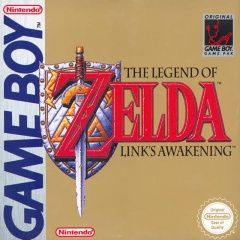
The Legend of Zelda: Link's Awakening
 My favorite game is—and most likely will always be—The Legend of Zelda: A Link to the Past.
It's a videogame that raised me, coddled me through the early years,
showed me the potential games held, and reminded me that there's still
good in this world. And strangely, there's never been anything quite
like it since its debut way back in November 1992. I guess some games do
come close: 3D Dot Game Heroes, Alundra, Beyond Oasis, and Dragon Quest Heroes: Rocket Slime. Not surprisingly, nobody does Zelda quite like Nintendo.
My favorite game is—and most likely will always be—The Legend of Zelda: A Link to the Past.
It's a videogame that raised me, coddled me through the early years,
showed me the potential games held, and reminded me that there's still
good in this world. And strangely, there's never been anything quite
like it since its debut way back in November 1992. I guess some games do
come close: 3D Dot Game Heroes, Alundra, Beyond Oasis, and Dragon Quest Heroes: Rocket Slime. Not surprisingly, nobody does Zelda quite like Nintendo.
Nintendo's 2011 E3 conference opened with some love for the Zelda franchise, now twenty-five years big, and a surprise announcement was that The Legend of Zelda: Link's Awakening was going to be available very soon on the Nintendo 3DS eshop. Sadly, I never got to experience this game before on the GameBoy, and a quick bit of research revealed that it both looked and played similar to what I consider to be gaming nirvana. Well, I downloaded it as soon as I could. Let's hope it lives up to my lofty expectations...
