
infamous
Infamous
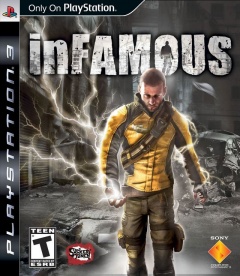 The whole “play the first hour of a video game and determine from that whether I’d keep playing” concept has its flaws, it’s certainly not perfect. Some great first hours fall short over time, and others give a bad first impression that they (sometimes) unknowingly recover from later on. But other times the first impression is right on, Infamous is one of those games.
I had a great time with the first 60 minutes of Infamous, the gameplay was fast-paced and just felt.. right. Plus, I’m always looking for sandbox games that pull off the action genre better than Grand Theft Auto IV (ugh). The Saboteur had similar first hour pedigree, and was also a great success in the end, so I had quite high hopes for Infamous.
You can probably tell by my praise that I enjoyed the game, so if you care to read on why I enjoyed it, well, here you go. My full review of Infamous for the PlayStation 3.
Infamous
There's something fun about playing catchup on a console like the PlayStation 3. I already know what most gamers think are the best games, and I can pick and choose from the rest that appeal to me. The games are cheap, the library huge, and the experiences brand new.
So here I am with Infamous (also known as inFAMOUS, but that's just awful), Developed by Sucker Punch Productions and released in mid 2009 on just the PlayStation 3. It didn't leave much of an impression with me at the time except that it was going head to head with a game called Prototype, which from afar seemed like a relatively similar gaming experience. Both games were successful in their own right, Infamous 2 landed last year which Nate reviewed, and Prototype 2 shipped last month.
Infamous is my fourth PS3 catchup game this year, following Batman: Arkham City, Heavy Rain, and Uncharted: Drake's Fortune. I've enjoyed them all, and am currently very fond of the PS3 experience. Of course, I'm limiting myself so far to games I know are pretty great, so I may be biased. Here's my first hour review of Infamous.
2011 Game of the Year Awards
 Announcing the 2011 Game of the Year Awards from First Hour!
These aren't your normal awards, we cover everything from older game of the year to worst first hour. We also don't sum up votes on categories or anything either, we simply present each writer's thoughts on their pick, so if you don't like something, you know exactly who to blame! Of course, we do all this just for fun (spare time!) and buy all of our own games (real money!), so most of us don't even touch some of the big releases of the year. Woe to the unpaid game critic!
Infamous and The Beast
 (WARNING: This post discusses significant plot points of Infamous and
Infamous 2 in detail. You are now at the gates of Spoiler City. Turn
back if you intend to play the game with a blank slate someday.)
(WARNING: This post discusses significant plot points of Infamous and
Infamous 2 in detail. You are now at the gates of Spoiler City. Turn
back if you intend to play the game with a blank slate someday.)
One of the cornerstones of horror is mystery. People fear the unknown, enough so that they will fill in the blanks with their own personal hellspawn when presented with a few creepy clues. Things that go bump in the night don't need to bare glistening fangs or a bloody hook to terrify us: they just have to bump.
This connection is easily exploited to make a good scare even better. It sounds crazy that so many left theaters spooked after the Blair Witch Project, considering the titular monster was never shown, yet that's exactly why the movie was a hit. Cloverfield saw that success and adapted it to trailers and TV spots, depicting a Godzilla-level monster attack from the view of those unable to see the monster directly. Video games are catching on as well, with many praising Amnesia: The Dark Descent for providing scares when nothing's there.
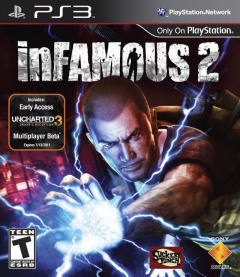
Infamous 2 isn't a horror game, but it makes excellent use of this deprivation technique to ramp up the suspense. The story's core is Cole MacGrath's quest to prepare for the destined arrival of The Beast, a being of such power and wrath that only at his fullest potential could the hero hope to stop it. Throughout the game, chilling reminders of this impending cataclysm are ever present, casting a shadow of despair that even overcasts Cole's considerable predicaments in the here and now. And when the Beast finally arrives, revealing itself at last to the wearied but hardened superman, the suspense is replaced with a dread so thick that it suffocates the player in a way no game ever has before.
Infamous 2 - Video
I vividly recall some trials and frustrations in my time with the
original inFAMOUS (not the least of which was that horrible spelling
which will henceforth be abandoned), but overall I really enjoyed the
game. As much as the sticky platforming, messy mission design, and
transparent morality system bothered me, I ultimately had a great time
surfing on power lines, tossing electric grenades, and guiding a
concentrated lightning storm down alleys of soon-to-be-corpses. It was
inevitable that the game would get a sequel due to its ending (and the
sad, predictable nature of this industry), and I really hoped that
Sucker Punch would iron out a few of the teeth-grating problems I had
with the original.
Lo and behold, it's one month and two years later, and there's another Infamous game. Boasting a locale with more colors than gray, melee combat that's not completely worthless, and the promise of acquiring more elemental powers, Infamous 2 certainly seems like the kind of sequel that boasts incremental improvements over the original and hasn't yet worn out the franchise's welcome. Pretty typical of a "2," really.
I find it amusing that the game arrived in my mailbox last Monday, the same day that Sony featured a trailer from the game in its E3 conference. Shortly after their presentation, I had my first taste of Infamous 2. I grabbed three clips from my first hour: arrival at the new sandbox city of New Marais, the first new power tutorial, and an early choice between good and evil sidequests.
E3 2010 Predictions Results
 Like scampering down the stairs on Christmas morning, the excited search for a steady video feed before E3 conferences is filled with anticipation. The annual summer happening is one of the few times on the gaming industry's calendar when we can look forward to some surprise delights from the many publishers playing the role of Santa Claus in business suits. Simply put, it's the industry's biggest event in the year.
As such, the editors of The First Hour tried to guess what unexpected pleasures would manifest at the event. Some were sure bets, like Microsoft showing off Halo: Reach. Others were more risky, like F-Zero hitting the 3DS at launch. And some were planted firmly outside the realm of possibility, with Shenmue 3 topping that list as always.
When all was said and done, The First Hour hit a few out of the park...but mostly struck out.
The QTE cure: Singin' in the Heavy Rain
 Quick Time Events. Ever since God of War and Resident Evil 4 exploded
onto the scene with button-prompt sequences of gore and horror, the
industry has shown its sheep-like nature and incorporated these Gotcha!
moments into games without thinking about how they make an
interactive experience better. Many gamers have adjusted to the fact
that every cutscene now has an awful series of play buttons throughout, but I
personally would like to cram all the QTEs in the world into a space
shuttle full of cobras and launch them directly into the sun if it meant
I'd never have to see another one again.
Quick Time Events. Ever since God of War and Resident Evil 4 exploded
onto the scene with button-prompt sequences of gore and horror, the
industry has shown its sheep-like nature and incorporated these Gotcha!
moments into games without thinking about how they make an
interactive experience better. Many gamers have adjusted to the fact
that every cutscene now has an awful series of play buttons throughout, but I
personally would like to cram all the QTEs in the world into a space
shuttle full of cobras and launch them directly into the sun if it meant
I'd never have to see another one again.
That said, it's not impossible to come across decent use of QTEs.
Indeed, before Resident Evil 4 set the standard at the advent of 2005,
the mechanic was most prominently-used by the Dreamcast's crown jewel,
Shenmue. In fact, it was Yu Suzuki, that game's director, who coined the
term "Quick Time Event." Suzuki put the gimmick to good use throughout
Shenmue, allowing protagonist Ryo Hazuki to do everything from tossing
drunkards around in bar brawls to saving little girls from incoming
soccer balls. One of the reasons the game is so beloved today is that it
allowed the player to engage in such a wide variety of scenarios, many
of which were supported with smartly-designed QTEs.
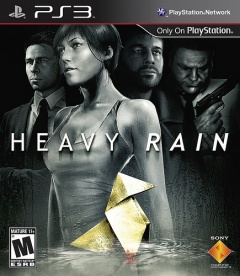
Good QTEs didn't end with Shenmue, however, even though sometimes it seems that's the case. Like God of War, other Playstation heavyweights have managed to use QTEs to enhance a game experience. I think it's only fair that we look at a few of those, as well as some alternatives to these timed button-prompts for cinematic flair in games.
