
platformer
New Super Mario Bros. Wii
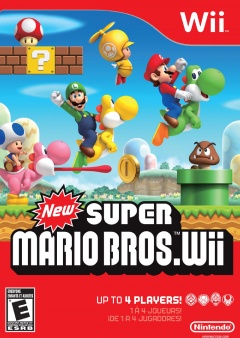 My oldest son is four years old now, I’ve been playing games with him since he was one. In some ways, gaming is a lot more accessible now: Wii Fit, touch gaming, and even the Kinect allow little kids and casual gamers to ease into things like never before. But on the other hand, give a toddler an Xbox 360 controllers with its nine buttons, two triggers, two thumbsticks, and a D-pad, and they’re more likely to send Batman sailing to an icy death.
So that’s how my Wii has been resurrected. Having collected dust for years, its wide array of kid friendly but adult awesome games is a godsend. We recently played through Donkey Kong Country Returns, and have now finished New Super Mario Bros. Wii. This is a newbie attractive game that features an especially excellent and forgiving cooperative mode. We can both play at the same time, and the punishment for death is rather limited.
But that’s not to say New Super Mario Bros. Wii isn’t challenging, and it certainly doesn’t lack in content or even replayability. Let’s take a deeper look at NSMBW, played completely through in cooperative mode with a four year old.
Ratchet & Clank: All 4 One
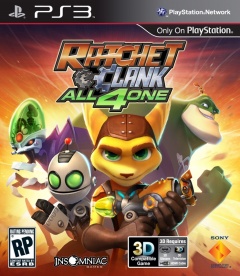 Since picking up copies of PC Gamer back in the mid 90s, I’ve only ever played a few game demos that actually made me want to buy the final product. The free demo should be the ultimate introduction to the game, the perfectly crafted first hour. But for whatever reason, being tossed into the middle of the game just doesn’t sit right with me. Whether it’s out of context cutscenes or repetitive gameplay, it doesn’t take me much to cross it off my list.
My only previous experience with the Ratchet & Clank series was a demo for one of the PS2 titles (it’s hard to nail down which one since they were released every 12 months like clockwork) which opened with what felt like a 20 minute cutscene. Unskippable cutscene. I didn’t even make it to the gameplay before the console was reset out of anger and annoyance. I don’t play a Ratchet & Clank demo to learn about its amazing storyline, I play for whatever shooting/platforming/clanking it has to offer.
So here I am with the first hour of Ratchet & Clank: All 4 One for the PlayStation 3. Released late last year, it’s still the newest game in the series... no, wait. Ratchet & Clank: Full Frontal Assault was released last week. So now we’re playing an out-of-date version of a has-been series. Here we go.
Trine 2: Goblin Menace
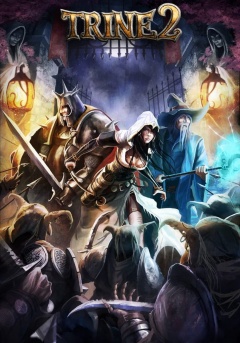 Trine 2 was a fun game, and its simple but challenging formula of platforming meets cooperative puzzling should be pretty easy to extend. Thus enter Goblin Menace, the first DLC available for the late 2011 release. We don't cover a lot of downloable content here, and most of it is for games like Mass Effect or Borderlands where the developer has so many more ideas for new characters and storylines that just couldn't fit in the original game. Frozenbyte, on the other hand, is less concerned about introducing some new class to play as or world to save, but they do seem full to brim with ideas of completely awesome and insane locations to send our heroes.
Goblin Menace was released in September and can be purchased for $8 on Steam. The DLC was not released on the PlayStation 3 or Xbox 360, but will be available on the Wii U along with the full Trine 2 game when the system is launched next month. Two Steam keys for Trine 2: Goblin Menace were given to us by Frozenbyte.
Rayman Jungle Run
 After playing Rayman Origins earlier this year, I was eager for more Rayman run-and-jump. Not long afterwards, Rayman Legends details started leaking out at E3, and the salivating began. Unfortunately for me, Legends looks to be a Wii U exclusive, and I'll probably have to miss out on Wii U at launch.
So I'll probably have to wait a while for the next big Rayman platforming adventure. But Rayman Jungle Run on my Android phone is a decent consolation prize.
In brief, it's the aesthetics and mechanics of Rayman Origins applied to Canabalt-style auto-running. Rayman charges through gorgeous hand-drawn environments, racing towards the goal and collecting Lums in thirty second stages. Its smartphone-simple design means Jungle Run sacrifices some of the creativity, variety, and exploration of Origins, but it's got a few advantages of its own.
Donkey Kong Country Returns
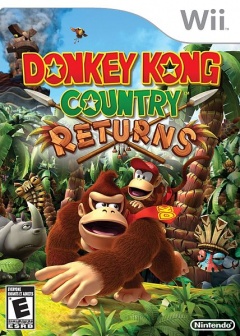 I’m not sure if we ever needed to return to Donkey Kong Country. The original series is so firmly a product of the Super Nintendo era, with its shiny, Toy Story look that is unique to Rareware, and pretty bad collision detection for a 2D platformer, I would have been okay with having rose-colored memories about my trips with DK, Diddy, and the rest of the forgotten gang.
But Retro Studios, apparently bored with resurrecting Metroid moneybags every few years, was tasked with bringing back the old gorilla in Donkey Kong Country Returns. Surprisingly, this was not another 3D incarnation that Retro seemed to excel at (Remember DK64? No? Good.), but a pretty straight enhancement of the originals. The world was still 2D, but with a bit more depth, and all the old standbys were there: bananas and letters to collect, barrels to get shot out of, and obnoxious boss battles.
Released in 2010, Donkey Kong Country Returns has already earned a prestigious 10 from Jonathan Ramundi, and while I would have written a review no matter how much I agreed or disagreed, I have a rather differing opinion about the game.
Trine 2
Growing up, playing a game cooperatively usually meant sitting down
with a friend in front of my NES playing Contra, Teenage Mutant Ninja
Turtles, or Chip 'n Dale Rescue Rangers. The game was either made easier
with a second player (twice as many bullets!), or twice as hard (fellow
chipmunks can be used as weapons!). But as games have evolved from the
living room to the internet, cooperative play has changed too.
Portal 2 was designed with two campaigns in mind, one for the single player and the other for multiplayer, specifically a cooperative experience with no traditional way to communicate available. Both sets of levels were brilliant in their own right, and excelled in creating a unique undertaking. On the other hand, the original Trine was made for local gaming only. Friends gathered in front of the TV or monitor and lead the trio of heroes on their adventure.
Trine 2 introduces online co-op for up to three gamers, fixes many complaints from the first game, and features some of the most gorgeous graphics I've ever seen in a video game. I finally got to tax my video card. Steve and I played through the entire game together online without voice communication, here are our thoughts.
New Super Mario Bros. 2
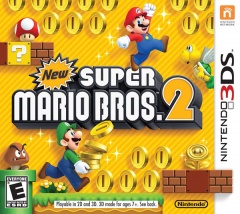 The announcement of a new Mario title tends to carry some buzz. Gaming’s mascot has led enough revolutions that every new game seems to emanate with potential energy.
But the fanfare was light when two new Mario platformers were revealed at this year’s E3. Old Jumpman may be a victim of overexposure: assuming New Super Mario Bros. U launches alongside the Wii U this holiday season, that will make five Mario platformers released in three years. The five previous Mario platformers stretched from 2007 all the way back to 1992.
You’ll never hear me complain about too many Mario games. I loved NSMB Wii’s hilarious multiplayer, adored Galaxy 2’s imaginative splendor, and even enjoyed 3D Land’s muted creativity. But all I expect from New Super Mario Bros. 2 is the same old unassuming excellence that has come to define the word “New” on Mario’s box.
Bit.Trip Runner
 VVVVVV and NightSky both featured great musical soundtracks to back their platforming efforts, but Bit.Trip Runner is essentially a rhythm game with the platforms serving the soundtrack. Developed by Gaijin Games and released on WiiWare in 2010 and Windows in 2011, Bit.Trip Runner attempts to marry the sounds of Guitar Hero and the auto-running of Canabalt.
Nate originally reviewed Bit.Trip Runner last year and deemed it the “anti-rhythm game”, he awarded it an average score and went on to call it stressful. Steve chimed in in the comments section a few months ago and agreed with Nate’s assessment, but for whatever reason, I decided to play it myself.
I didn’t actually beat Bit.Trip Runner, but I made it to the third to last level before finally giving up, so I feel like writing a “full” review is still legitimate, either way, full disclosure.
NightSky
 NightSky sells itself as an “ambient action-puzzle game”, which is an excellent description for this unique platformer. Most of the time you’re rolling a ball from the left to the right to reach the far side of the screen. Each level is typically three screens, with the third screen serving as a visual addendum to the previous puzzle. I’d like to say it’s a deceptively simple game, but there really isn’t much more to it than rolling a ball.
Outside of games like Eufloria and Dear Esther, few video games have delivered a truly relaxing experience. There’s very little urgency in NightSky with only a couple of timed puzzles, and if your ball rolls into the abyss, you’re simply plopped back to the beginning of the three screen set. You can save and quit at any time without losing progress, and there isn’t even really an acknowledgement that you beat the game. Everything is designed to elicit as little positive or negative emotions as possible, developer Nicklas Nygren would probably deem it a success if you instead drifted off to sleep in your chair.
VVVVVV
 I’ve been on an indie game kick this year, playing some really excellent platformer and adventure games. In a somewhat random string of events, I ended up playing three pretty different types of platformers over the course of a few weeks, and in preparation for our recent five year anniversary celebration, all full reviews were put on the back burner.
The first of these three is VVVVVV, developed by Terry Cavanagh and released in early 2010, VVVVVV is a short but challenging open world platformer. Our hero, Captain Viridian, suffers some kind of accident to his spaceship and his crew is scattered across a new dimension. The controls are simple: all you can do is move left, right, and well, flip the gravity at your whim.
The next two platformers you’ll hear from me about are NightSky and Bit.Trip Runner, and while they’re all technically rather distinct, they can, after all, be boiled down to 2D platformers at the core.
