
Greg Noe's reviews and writings
Games for Lunch calling it wraps
In a bit of sad news, Kyle Orland's original one hour gaming blog, Games for Lunch is on official hiatus. Kyle started Games for Lunch about a month or so before I founded The First Hour (to both my surprise and dismay at the time, complete independently) and has just written his 500th first hour review before heading into limbo. Kyle relied on other gaming sites to pay for his five(!) reviews a week and that has all dried up. We here at The First Hour were never quite as ambitious, so going from making nothing to making nothing wouldn't affect us as much.
With Kyle finished, The First Hour is part of a very small group of sites still writing anything like a first hour review. Game Trailer's Hour One only made it through five videos before seemingly giving up, but Kotaku Australia still publishes them periodically. Here's hoping a few other sites give it a try in the future.
We still plan to chug along though as I have no plans to quit. I've got a couple of games in my queue to write first hour reviews for, and our team of seven other writers always have things cooking up. If you have any suggestions on games to play, drop me a line at greg@firsthour.net
Alpha Protocol
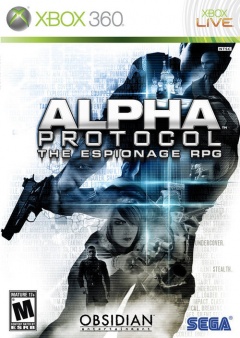 Alpha Protocol is Obsidian Entertainment’s first original title after a history of picking up series where BioWare left off, including Knights of the Old Republic. Released about two months ago and published by Sega, Alpha Protocol is subtitled “The Espionage RPG.” Definitely an enticing combination of words for fans of Western RPGs.
Critics rewarded the game a very wide range of scores, from 20% to over 80%, so it sounds like we have a love/hate game on our hands. There’s obviously something in Alpha Protocol that appeals to some gamers, so I’ve decided to give it a try myself. I’m a huge fan of the Mass Effect series, and from a distance, Alpha Protocol appears to be an attempt to replicate its success.
Word has already come out that the cold reception the game received has scrubbed any chance for a sequel, but Obsidian shouldn't complain too much since they're currently responsible for developing Fallout: New Vegas and Dungeon Siege 3.
So let’s not waste any more time and get into the first hour of Alpha Protocol for the Xbox 360.
Picross 3D
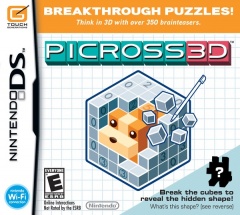 I can't name a lot of puzzle games I've honestly enjoyed. Tetris Attack, the Professor Layton series if those count, World of Goo? As you can tell I'm not a huge fan of the genre. I might play a puzzle game for a few rounds before I become bored, but Picross 3D was different, really different. I've already managed to beat over 200 levels and was becoming so obsessed with the game I was carrying my DS to work in case the opportunity came up over lunch.
Picross 3D is not a typical puzzle game, it's slow moving and requires a lot of careful thought. There is little guessing involved and it does an excellent job of driving you on from puzzle to puzzle. As someone who had never played a Picross game before, I really had no idea what I was getting into until I read Nate's half hour review of the game. The game is cheap though so there's little investment for a chance of tons of hours of gaming. Plus it reminds me of my Kakuro obsession during my senior year of college.
Get ready for my shortest review ever!
LEGO Rock Band DS is the longtime sequel I've been waiting for
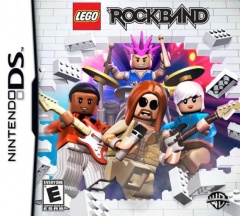 No, I'm not really excited that it's another Rock Band game or even yet another LEGO game, but that LEGO Rock Band DS is essentially the direct sequel to Harmonix's original rhythm games: Frequency and Amplitude. For the unfamiliar, Harmonix's first two games were essentially the precursor to Rock Band where you played multiple instruments, but the catch was you had to flip between instruments after successfully playing a few measures of another. The gameplay was quite a bit more complex than Harmonix's original Guitar Hero games as there were multiple sets of scrolling notes that you had to keep an eye on to efficiently keep your streak going.
The Legend of Zelda: Twilight Princess
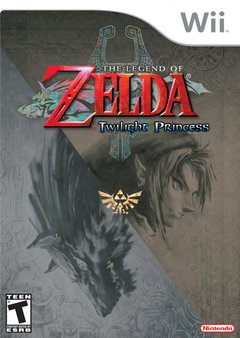 It's hard for me to go an entire year without playing some Legend of Zelda game, heck, just the first half of this year included Spirit Tracks and The Minish Cap, so why not feature the first hour of another? The Legend of Zelda: Twilight Princess was released in 2006 on the Nintendo Wii and GameCube. It was originally going to be for just the GameCube, but Nintendo thought it would make for a great launch title on the Wii (which it did, got me to buy the system), so then the GameCube release was delayed a month to let sales of the Wii version have free reign.
Twilight Princess went on to win game of the year awards and was generally praised around the industry for its gameplay and presentation. For the sake of full disclosure, I beat Twilight Princess within a few weeks of its release on the Wii and have mixed feelings about the game. It's been almost four years though since I've played it so here is its second chance with me in the form of the first hour review of The Legend of Zelda: Twilight Princess for the Wii.
The First Hour celebrates three years of starting new games
Three years ago I was starting my first game of God of War II and after about an hour of playing, thought, "that was incredible!" I dug out a notebook and pencil, and began replaying what I had just finished, but taking notes this time at each minute. The First Hour was born.
Since then we've posted 140 first hour reviews, 75 full reviews, and many more reviews and writings of a bunch of other video game related topics. We've also grown from one writer, me, posting once a week to an audience of few, to a team of nine writers publishing content every weekday to an audience of many (many being relative). The First Hour is a modest site, and I couldn't be happier with where it is three years after it began.
I don't want to make a bigger deal out of this than it is, but thank you everyone for reading and telling your friends. We love video games, and we love writing about them. It is our passion and the First Hour is our outlet.
Remaking Japanese RPGs into Western RPGs
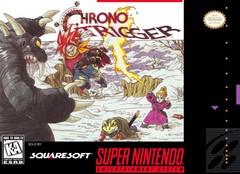 Obsidian Entertainment recently mentioned that they would like to remake Chrono Trigger into a Western-style console role-playing game and the gaming world went, "huh?" I personally like the idea, while the usual haters are going to hate, but this actually has a small chance in happening since Square Enix recently recruited Obsidian to work on the Dungeon Siege IP Square picked up recently. So the companies have a relationship, anything could happen now.
As a gigantic fan of Chrono Trigger, the idea of a remake honestly doesn't bother me. Any Chrono game at this point is better than no more Chrono games. Square Enix has shown over and over again that they will never come back to the series in any serious form, so why not contract it out to a studio that is actually interested (and experienced in picking up old IPs, if somewhat lousy at it sometimes)? Chrono Trigger on the Super Nintendo and its ports to the PS1 and DS sold over 3 million copies, but sales outside of Japan have always lagged, why not take one of the best games ever and adapt it to a new audience? There's definitely potential.
Borderlands: The Zombie Island of Dr. Ned
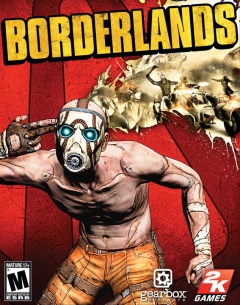 If there’s a formula that has worked the last couple of years for video games, it is that zombies makes things more fun. Call of Duty: World at War was wildly successful with Nazi Zombie mode, and the Left 4 Dead series is one of the most popular online games played today. In the near future, Dead Rising 2 will be released and Crackdown 2 will feature zombies roaming around the city during the night. Just about the only series moving away from zombies is Resident Evil, with both 4 and 5 featuring a lack of undead we know and love.
So it probably came of little surprise when Gearbox announced the first piece of downloadable content for Borderlands would be about zombies. The Zombie Island of Dr. Ned to be exact. The name itself is intriguing to veterans of the game, as Dr. Zed was a friendly NPC that helped you on your quest for the Vault, raising the question: who is Dr. Ned compared to Dr. Zed?
The answers lie within this multi-hour extra, along with many, many zombies to blow away. This DLC is available via download or by buying the Double Game Add-on Pack disc which contains Zombie Island and Mad Moxxi’s Underdome Riot, which I’ll be playing next. The disc is useful for a number of reasons, while the initial price is the same as if you bought the add-ons online, you can pass the disc on to friends or even resell it. The only catch is if your hard drive gets wiped or you uninstall the content, you’ll have to install the DLC from the disc again.
PC Gamer - June 1996 - Star Wars goes Multiplayer
 When selecting my next magazine to read with rose-colored glasses, I
decided to go with PC Gamer, a magazine that was hugely influential
over my middle and high school years. I never actually had a
subscription to PC Gamer, I instead bought single issues of it in
preparation for long vacations in the car as my family drove to Florida
or New Jersey. PC Gamer was always more "adult" for me. I didn't have
a lot of experience to base this on besides Nintendo Power and Game
Players, but PC gaming was always inherently edgier and PC Gamer was
written for a slightly older crowd.
When selecting my next magazine to read with rose-colored glasses, I
decided to go with PC Gamer, a magazine that was hugely influential
over my middle and high school years. I never actually had a
subscription to PC Gamer, I instead bought single issues of it in
preparation for long vacations in the car as my family drove to Florida
or New Jersey. PC Gamer was always more "adult" for me. I didn't have
a lot of experience to base this on besides Nintendo Power and Game
Players, but PC gaming was always inherently edgier and PC Gamer was
written for a slightly older crowd.
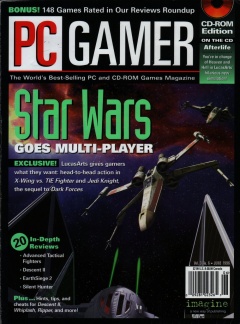
So of the 13 issues of PC Gamer I apparently still own, my first was the June 1996 featuring X-Wing vs. TIE Fighter on the cover. The moment I saw this issue at the local Shopko, I undoubtedly became a man. Not only was I a huge Star Wars fan, but I had loved the original TIE Fighter and the magazine came with a CD. My very own compact disc filled with game demos and an AOL installation!
Hopefully I won't go as in depth with this issue as I did with my first issue of Nintendo Power (I did, whoops). I couldn't find this magazine scanned already online, so I did the scans myself, I apologize that they suck. Let's dive into PC Gamer 14 years ago.
The Warning Signs of Bootleg Games
 I buy a lot of my games used, most of them, in fact. I can't even remember the last game before Mass Effect 2 that I purchased brand new in a box, it's just something I've decided is both out of my budget and totally unnecessary. I've already beaten 13 games this year and have enjoyed most of them, and through a combination of buying used on Amazon, borrowing from friends, presents, spending money on deals for digital games, and a few lucky review copies from publishers, I calculated I've spent less that $100 on games this year, and that was with the $70 Mass Effect 2 Collector's Edition!
So when confronted with the idea of spending $60 on a new game that will be available for $40 in three weeks, $25 in three months, or $10 in three years, I generally think twice. The used game market is my friend, and I play both sides of it. However, sometimes an older game suddenly strikes my attention and I'm quickly making what seems like a steal of a deal, only to be burned later when I find out the game I received is actually a fake, a bootleg, a counterfeit cartridge or disc.
I've determined over the years that there are warning signs for bootleg games, so I'd like to share them with you. These are just general warnings, and even if you follow all of them you might receive something fake. I'm also not discouraging anyone from buying used games online, as I think they're extremely valuable resources that save gamers tons of money.
This was originally going to be part of my Legend of Zelda: The Minish Cap review from yesterday, but I decided to break it into its own post as I believe the information stands on its own.
