
Mirror's Edge
| Mirror's Edge | |
|---|---|
 |
|
| Platforms | Windows, Xbox 360, PS3 |
| Genre | First person parkour |
| Score | 8  |
| Buy from Amazon | |
Think about your favorite part of any platformer game, it probably has something to do with excellent level designed coupled with you being in the zone and cruising through the stage on a perfect run. Like in Super Mario Bros. 3 where you bounce from goomba to goomba and take off in flight as Raccoon Mario.
Now think about the worst part in any platformer, for me, it's when a platformer stops being a platformer and tries its hand at something... less than adequate. This might mean boss fights that require more luck than skill or high action sequences that seem better at home in a much different genre.
Mirror's Edge is a prime example of a game where excellent platforming level design collides with obnoxiously out of place non-platforming. Thankfully, the highs outweigh the lows in this ambitious first person platformer. The game was released on the Xbox 360, PlayStation 3, and Windows in 2008 and was planned to be the first game in planned trilogy. Sales apparently weren't good enough for Electronic Arts and no word of a sequel has been announced. Though in classic industry PR, they "haven't not not" announced Mirror's Edge 2.
This is the First Hour's second opinion on Mirror's Edge along with my conclusion after playing its first hour earlier this month. Here's my full review of Mirror's Edge.
What I loved: Lots of things, actually. Everything from the eerily crisp graphics to the soundtrack, along with most of the gameplay too. Heck, I even kind of liked the story. Mirror's Edge is a great, complete package with a few significant stumbles.
I talk significantly below about what I didn't like about the game, so please don't compare the amount of words I spend on where I feel the game went wrong on where I feel the game went right. Most of my praise will be found in the specific categories below.
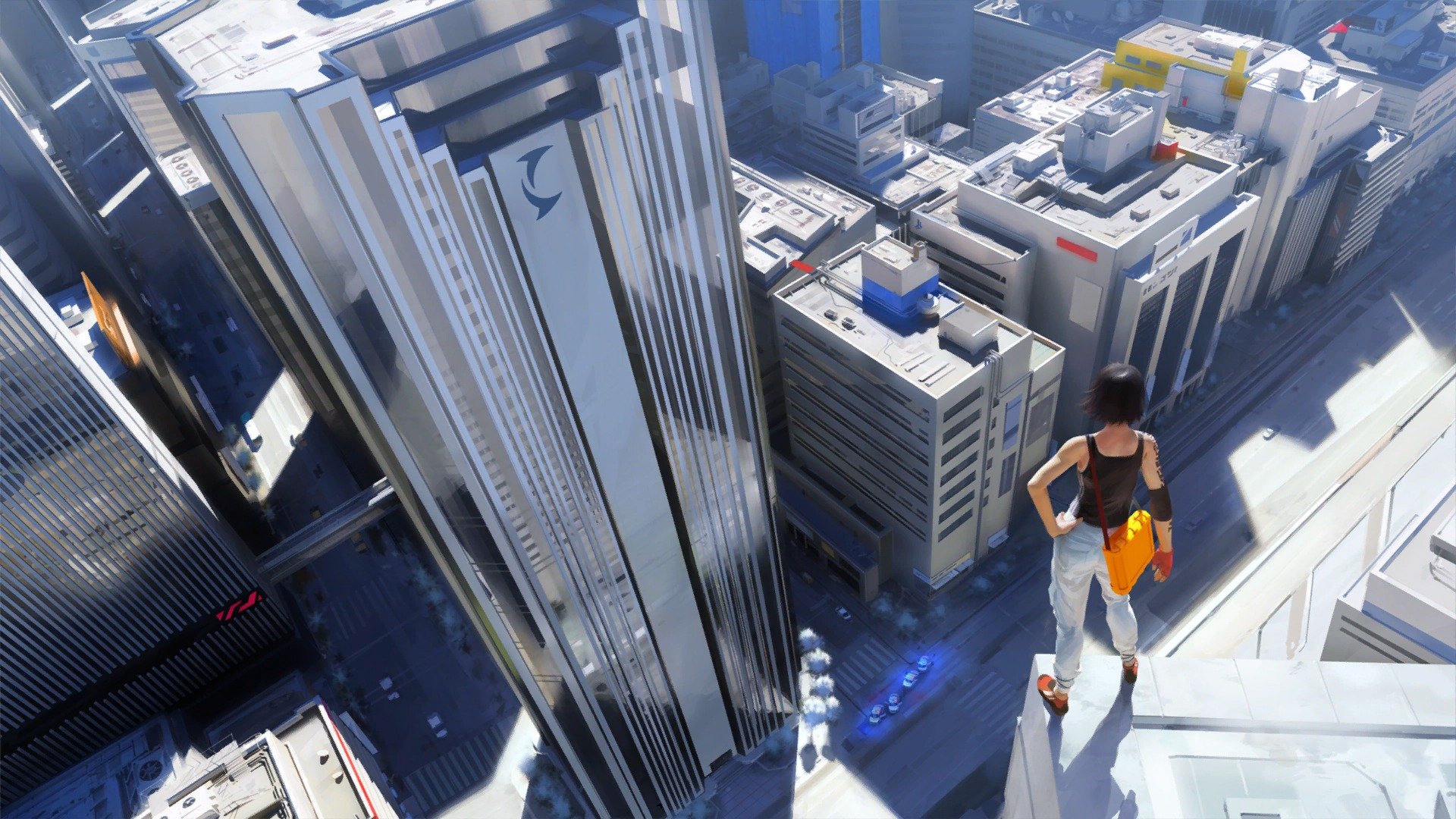
Something I would like to point out is how Mirror's Edge is a "good" linear game. What I mean is that while the game appears very open, the level design is always silently pushing you in the right direction without being too overt about it. I have no idea what this is called besides excellent level design, but another example I always think back to is the opening level of Halo where you're dashing through the spaceship during the Covenant attack. It seems like you could explore the whole ship if you wanted to (you can't), but scripted events are always grabbing your attention and keeping you focused while masking the linearity of the stage. If someone knows how to define this, please let me know.
What I hated: I decided to wait a week before writing this review. When I finished the game, I was boiling over with anger at the developers. Not at the what-it's-over-already ending, but because of the maddening amount of not-parkouring you go through in the last hour or so. What makes Mirror's Edge such a memorable game is the unique way it handles the traditional platformer. Not only does the first person view work spectacularly, but it almost seems to improve upon the usual third person view we're so used to jumping around in. The big problems creep up when Mirror's Edge forgets about its platforming roots and instead sways towards its first person shooter second-cousins.
I thought it was kind of cool how you could knock guns out of the hands of a police officer and turn the tables on his buddies with it, but that was during the tutorial. Once in the game when I was actually forced to execute these maneuvers, things started going downhill. First of all, to steal a gun you need to click the right mouse button when the gun glows red. This lasts about a quarter of a second; a blink and you miss it QTE. So then you have to slow down time with Faith's special ability which was seemingly intended to be used to pull off complex jumps and wall runs, but instead devolves into your only survival tactic against the police.
So now that you have a gun, you get to fire back a limited number of shots before you throw it away. Most guns don't have a reticle (even though I specifically made sure the reticle was on in the options multiple times), so you just sort of wildly shoot it in the direction of baddies. If you kill them, you'll probably survive this section, if you fail, you get to try again and again until you succeed. Also, while carrying a gun, you can't run or jump very high, so there's pretty much a gun mode and a running mode in Mirror's Edge, don't mix the two up.
For the first half of the game, these shooting encounters aren't that big of a deal. Most of the time, you can even run past the police and just hope they miss shooting you as you vault over a fence. But later in the game, there are many situations where you absolutely have to fight back to survive. Whether this means stealing a gun and mowing them all down or systematically knocking them out with your kung-fu powers, it detracts tremendously from the game. Especially as you can die so easily from a few well placed bullets.
So Mirror's Edge really ends up suffering trying to be more than what it should be. It does itself no favors forcing you into combat situations as it exposes the developers and the game for shoddy artificial intelligence and first person shooter gameplay. Stick with what you do best.
I will admit that I enjoyed the one-on-one boss battle about mid-way through the game, the kung-fu only action seemed better executed that me getting shot in the face repeatedly.
Scores
Gameplay: 9
I've never personally scaled a building using just my hands and feet, nor have I wall jumped 100 feet above the street, but I have played Mirror's Edge, so I know for sure I'll never want to do these things either. While I know the game is just a game, Mirror's Edge played so well that I feel like I pulled off some of Faith's moves myself. It's such a trascendent feeling playing a game like this, I don't think I've ever felt anything like it before. Faith moves so smooth and all your maneuvers feel very natural. You can feel her slide under pipes and grip the edge of a building with just her fingertips. And the first time you fall hundreds of feet to the street below, you will shiver.
Fun Factor: 7
Most of the outdoor action is really fluid and fun, the speed of the game degrades a bit indoors, especially when you're traveling more vertically than horizontally. And honestly, my level of enjoyment was tied directly to how fast I was moving. Whenever I was hopping from building to building, I was having a great time, when I was indoors crawling through ducts and wall jumping it was pretty good, when I was forced to stop running and fight, well, that was just bad.
Graphics and Sound: 10
Mirror's Edge is the cleanest, most straight-edged game I've ever played. The city is immaculately clean and the color palette is smartly limited to make every graphical feature pop out. The physics are excellent, especially some of the cloth physics that are used for hanging plastic - it dangles so well!
The music is very dynamic and reacts to every situation, and the voice work, while not spectacular, does the job really well. The number of actors is pretty small but I never felt removed from the game.
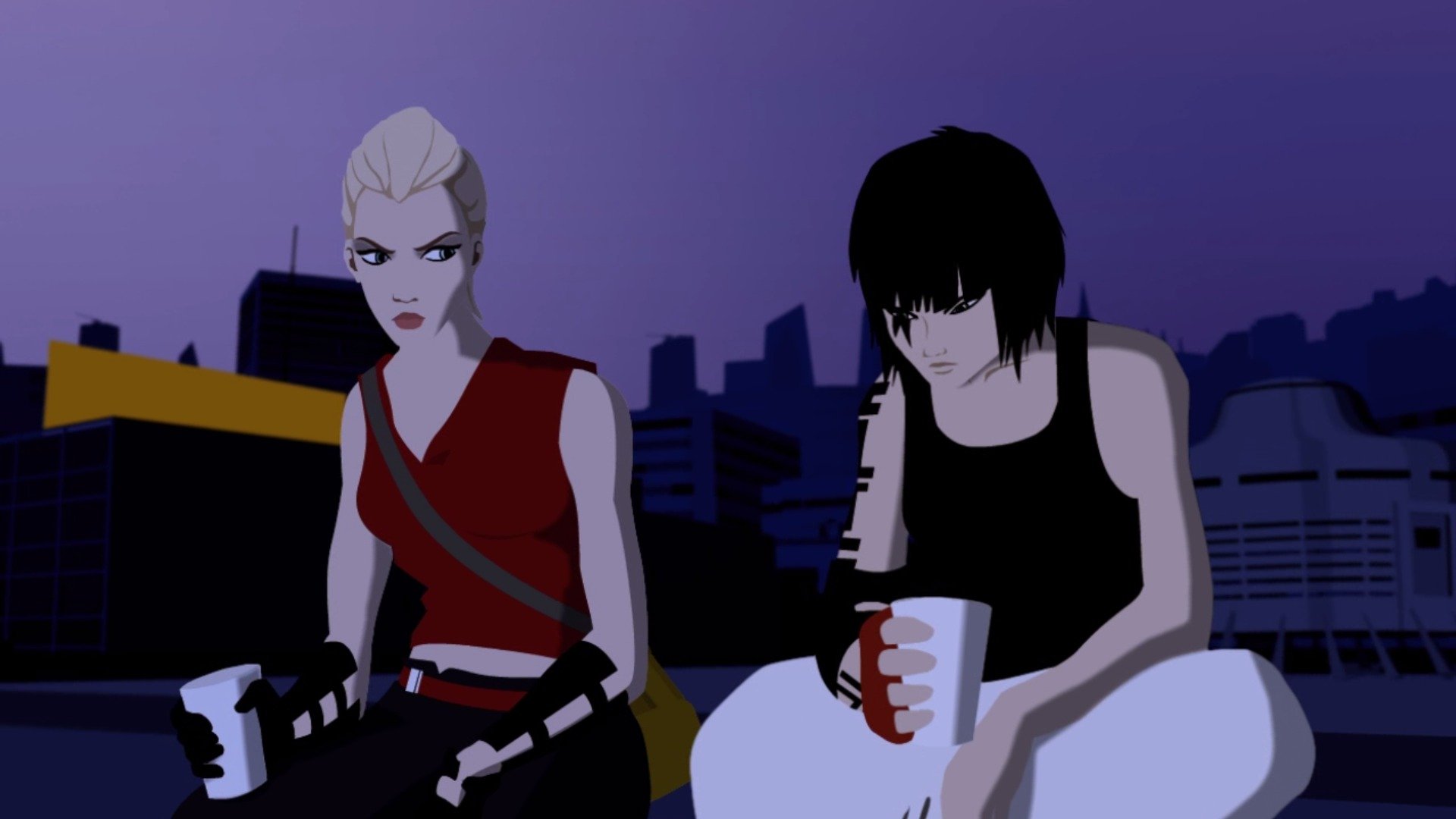
Mirror's Edge's cutscenes are presented in a densely cel-shaded art style. While I didn't mind the look, it seemed really out of place from the rest of the game, and seemed oddly presented in a lower resolution.
Story: 7
Mirror's Edge plot is well contained and doesn't waste a lot of time on frivolous extras. In the first level, someone dear to Faith is framed for a crime and the rest of the game has you following leads across the sky. Each stage starts you out somewhere far away from your destination and it's your job to get there, cutscenes are short and most of the story is told through voice overs while you're traveling from point A to point B. Always the most effective form of exposition, if you ask me.
The ending feels a bit rushed, but mostly because it doesn't wrap up perfectly. I still enjoyed it, though I thought before the final QTE event played out there was going to be at least one more level.
Overall: 8
I was originally going to score Mirror's Edge a 7, but after letting myself cool for a week, I realized how much of the game I really did enjoy. Yes, the combat sequences were infuriating, but I understand why they tried them and if Mirror's Edge 2 is ever made, I can see this being a focus on what to fix. So all-in-all, Mirror's Edge is a great game with some issues, but it's so cheap now that I heartily recommend you pick it up.